Monday, 25 March 2013

R is for Richardoestesia

Last week, we discussed the giant pterosaur, Quetzalcoatlus. This week, we're back to dinosaurs from Alberta, with 'R is for Richardoestesia', which is the only dinosaur from Alberta that starts with 'R'.

Richardoestesia was a medium-sized theropod that lived mainly in the Late Cretaceous (76-75 million years ago) of North America. The holotype, a pair of lower jaws, was found by well known Canadian palaeontologist Charles Sternberg in Dinosaur Provincial Park in 1917. However, it remained un-named until 1924, when Charles Gilmore named a new genus Chirostenotes, and referred the jaws to this new genus. However, the rest of the skeleton of Chirostenotes was obviously from an oviraptorsaur, and this jaw was not, again leaving these jaws nameless. In 1990, Phil Currie and two colleagues named a new species Richardoestesia gilmorei, with these jaws as the holotype. The genus name comes from Richard Estes, to honour his significant research in small vertebrates in the Cretaceous, while the specific epithet honours Charles Gilmore, for his attempt to name it in 1924. These jaws are long and slender, with relatively small, finely serrated teeth having a whopping 5-6 denticles per mm. This high density of serrations is what distinguishes Richardoestesia from other genera. Although the holotype is actually represented by immature teeth, there are many, many mature shed teeth from older individuals in the fossil record [1]. 
Photo showing the serrations and examples of teeth from Richardoestesia gilmorei (left) and R. isosceles (right) from Larson and Currie [1]. Scale bar = 1mm.
Unfortunately, because Richardoestesia is known primarily from teeth, there is very little known about this dinosaur. Based on the size of the teeth, it is estimated to be a medium-sized theropod, around 100 kg. The teeth also tell us that it was a coelurosaur (which is a very broad group of dinosaurs), and that it was a carnivore based on the serrations. In fact, it was possibly a piscivore (fish-eater), at least this has been suggested for R. isosceles [2]. While Richardoestesia-like teeth have been reported from several other formations, a recent study has suggested that many of these teeth are significantly different from each other (7 different morphotypes), and that they may represent different species [1]. This study suggests that R. gilmorei is only definitely known from the Dinosaur Park Formation, and that it is distinctly different from  R. isosceles. This study was actually very important as it suggested that the number of small theropod dinosaurs in the Late Cretaceous of North America had been greatly underestimated. Previously, the lack of small-sized theropods was not fully understood as other contemporaneous ecosystems had several, while North America did not. While others tried to explain this lack, Larson and Currie looked at over 1100 fossil teeth from this area and suggested that it is possible to separate out species just from teeth, which brought the number of possible small theropod species in western North America to 23. 

Although there wasn't a lot to say about Richardoestesia as an animal, I hope this gave a bit of an insight into some of the challenges that palaeontologists face when it comes to fossils. I also hope that it revealed some of the painstaking methods that some palaeontologists go through to find information. 1100 dinosaur teeth! Wow!

Next week we'll be talking about another dinosaur from Alberta, but I haven't decided which one yet. Hadrosaur or theropod? Let me know which one I should do! 

References
1. Larson, D.W., and Currie, P.J. 2013. Multivariate analyses of small theropod dinosaur teeth and implications for paleoecological turnover through time. PLoS ONE 8: e54329. doi:10.1371/journal.pone.0054329
2. Sankey, J.T. 2001. Late Campanian southern dinosaurs, Aguja Formation, Big Bend, Texas. Journal of Paleontology 75: 208-215.

Monday, 18 March 2013

Q is for Quetzalcoatlus

As there are no dinosaurs from Alberta that start with 'Q', we are going to talk about an animal that may have lived in Alberta, although there are no confirmed fossils. Quetzalcoatlus was a giant pterosaur that lived in North America during the Late Cretaceous (70-65 million years ago). Remember that pterosaurs are not dinosaurs, contrary to popular belief. The name comes from the Mesoamerican feathered serpent god Quetzalcoatl. 

Quetzalcoatlus is famous for being the largest pterosaur known from decent remains. There are two different morphs, a smaller one with a wingspan of about 6 m, and a larger one with an estimated wingspan of 10-12 m. That's about the length of a yellow bus. Can you imagine an animal with wings the size of a yellow bus?! The first fossils were found in Texas and consisted of a partial wing of the large morph, while other partial specimens from Montana have been found of the smaller morph, including partial skulls. Pterosaur fossils are extremely rare in Alberta, however, one large neck vertebra found in Dinosaur Provincial Park may be from Quetzalcoatlus based on size and some distinctive features [1]. Another partial skeleton with tooth marks and an embedded tooth from Saurornitholestes, a small theropod, is from an azhdarchid pterosaur, the group that Quetzalcoatlus belongs to [2]. Quetzalcoatlus had a large skull with a toothless pointed beak and a small crest. Like other pterodactyloid pterosaurs, it had only a short tail. 
Skeletal replica/reconstruction of Quetzalcoatlus. Photo by Liz Martin
Their fragmentary remains and strange morphology have made it difficult to fully understand this animal. Many studies have looked at whether or not Quetzalcoatlus was capable of flying, and a feature most important with respect to flight capabilities: how much did it weigh? Unfortunately, this is a very difficult question to answer. Mass estimates for the large morph have ranged from75 to 544 kg, which is a huge difference. Although 75 kg certainly would have been light enough to fly, it is not physically possible to have an animal that size weigh so little. On the other hand, 544 kg surely would have prevented the animal from flying, which begs the question - why did they have such large wings? More recent estimates have suggested a mass around 250 kg which, according to different studies, may or may not have allowed it to fly. For a more detailed explanation on the mass estimates, check out these posts by pterosaur palaeontology student Liz Martin here and here. More recently, a study has suggested that large azhdarchid pterosaurs like Quetzalcoatlus were well adapted to life on land, and moved around on land, feeding by "terrestrial-stalking", but would have been capable of taking off and flying as well [3]. 
Artists impression of the 'terrestrial-stalking' feeding method of Quetzalcoatlus. Image copyright of Mark Witton [3].
Although some studies have suggested that Quetzalcoatlus fed by skimming the water for fish, this idea is unlikely for several reasons. These include the fact that the fossils are found 100's of km from the nearest palaeo-coastline, and that their skulls and necks lack features required for skim-feeding, like a doubly re-inforced jaw joint found in modern skimmers [3]. In terms of flight, some studies have suggested Quetzalcoatlus was flightless, while others have shown it may have been capable of flying 1000's of km, much like a modern albatross. In this case, it would have used a short burst of energy, followed by large amounts of thermal soaring, relying on the wind and thermals to carry them. 

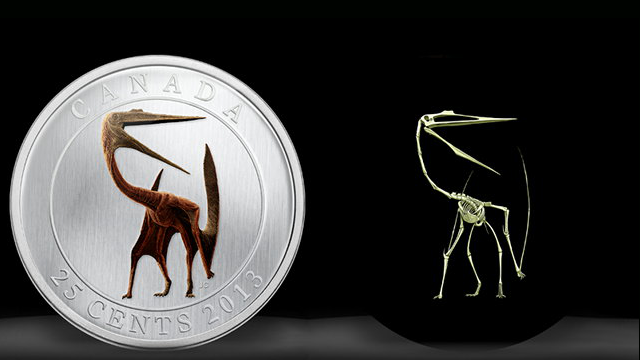
This is currently an exciting time for pterosaur research, and many people are looking at these animals, especially with respect to their biomechanics. There should be lots of interesting information and debates in the next few years! It is also interesting to note that Quetzalcoatlus was recently featured on a special edition Canadian quarter, the second in a series of prehistoric creatures. The image was made by a fantastic palaeo-artist Julius Csotonyi. This coin sold out rapidly, so I hope you got yours!
New 'glow-in-the-dark' special edition Canadian quarter featuring Quetzalcoatlus
Hopefully you enjoyed this post about Quetzalcoatlus, the huge pterosaur from North America. Watch for us next week when we talk about a small theropod dinosaur from Alberta!

References:
1. Currie, P.J., and Russell, D.A. 1982. A giant pterosaur (Reptilia: Archosauria) from the Judith River (Oldman) Formation of Alberta. Canadian Journal of Earth Sciences 19: 894-897.
2. Currie, P.J., and Jacobsen, A.R. 1995. An azhdarchid pterosaur eaten by a velociraptorine theropod. Canadian Journal of Earth Sciences 32: 922-925.
3. Witton, M.P., and Naish, D. 2008. A reappraisal of azhdarchid pterosaur functional morphology and paleoecology. PLoS ONE 3: e2271. Freely downloadable here

Monday, 11 March 2013

P is for Pachycephalosaurus

This week in our Albertan dinosaurian alphabet, we are going to talk about the (debatable) Albertan dinosaur Pachycephalosaurus. It lived during the Late Cretaceous (70-65 million years ago) of western North America, and specimens have been found in Montana, Wyoming, and possibly Alberta. The name means "thick-headed lizard", in reference to the very thick (up to 25 cm) domed skull found in these dinosaurs. One possible specimen has been found in Alberta, and has been referred to from the British Museum of Natural History. However, this record is very dubious [1]. This means that this dinosaur may not be found in Alberta after all. Because of this, I'll go through a short description of Pachycephalosaurus, why it's interesting, then talk about some similar ones that are found in Alberta. 

Strangely enough, this dinosaur is known only from portions of the skull: no postcranial remains have been found, meaning most of its body information comes from other closely related species. The skull is much larger than other related species, suggesting it stood as tall as 1.5 m high (with it's head leaning forward), a length of 4.5 m, and weighing 450 kg. Pachycephalosaurus has a very distinctive skull that makes this dinosaur famous. As mentioned previously, it had an extremely thick skull (up to 25 cm) that had a smooth dome-shape to it. At the back of the skull were several bony spikes and knobs, which are also found around the sides and even on its face. Like other pachycephalosaurids, it had sharp leaf-shaped teeth that would have been successful at eating tough fibrous plants, insects, and seeds. 
Artists impression of Pachycephalosaurus by Nobu Tamura
Pachycephalosaurus is perhaps most famous for what it may have done with its hard, domed head. Originally, it was thought that pachycephalosaurs used their round heads to smash into each others' heads, much like bighorn sheep or musk oxen today. This is the idea that has been picked up by popular media, and in fact appears in many books and movies. However, more recent studies have suggested that this would have been impossible. For example, one study suggests that the amount of force this would create would collapse the skull roof, which would obviously cause problems with the brain, although another study has suggested this is not the case [2-3]. Furthermore, the neck vertebrae are unable to lock in a straight position, which would result in a very unstable structure during collisions. Finally, the smooth, rounded surface of the dome would result in glancing blows, rather than direct contact with each other, which would be of further danger to the animal. Although these animals were likely not butting their heads against each other, they were likely using these thick skulls to butt something softer like the flank of other animals. This could have been used to intimidate another individual in something like a mating competition. 

So what about pachycephalosaurids from Alberta? First of all, a nearly complete specimen of Stegoceras was found in southern Alberta, and is actually housed at the University of Alberta. It was much smaller than Pachycephalosaurus, at 2 m long and weighing only an estimated 60 kg. Another possible Albertan pachycephalosaurid is Stygimoloch, which is found primarily in the US with a possible find in Alberta. It is smaller than Pachycephalosaurus, and has much pointier spikes sticking off of its skull. Some authors believe that Stygimoloch, along with another pachycephalosaur Dracorex (which has a species named after the Hogwarts castle from Harry Potter) actually represent a growth series with Pachycephalosaurus being the adult [4]. In fact, some of you may remember Dr. Jack Horner talking about this 2 summers ago at Jurassic Forest! 
Proposed growth series of Pachycephalosaurus. (G, H) represent the youngest in the series, Dracorex; (E, F) represent an incomplete specimen of Stygimoloch, slightly older; and the top two rows are specimens previously attributed to Pachycephalosaurus. Image from Horner and Goodwin [4].
I hope you enjoyed learning about this interesting dinosaur. Next week, we'll be on Q, which will bring us another non-Albertan dinosaur. 

Other 'P' dinosaurs from Alberta:
Prismatoolithus - a dinosaur egg genus
Prosaurolophus - a hadrosaur 
Parasaurolophus - a hadrosaur
Pachyrhinosaurus - a ceratopsian
Prenoceratops - a ceratopsian
Panoplosaurus - an ankylosaur

References:
1. Ryan, M.J., and Russell, A.P. 2001. Dinosaurs of Alberta. In D.H. Tanke and K. Carpenter eds. Mesozoic Vertebrate Life. Indiana University Press.
2. Carpenter, K. 1997. Agonistic behaviour in pachycephalosaurs (Ornithischia, Dinosauria); a new look at head-butting behaviour. Rocky Mountain Geology 32: 19-25.
3. Snively, E., and Cox, A. 2008. Structural mechanics of pachycephalosaur crania permitted head-butting behaviour. Palaeontologia Electronica 11: 3A. Freely downloadable here
4. Horner, J.R., and Goodwin, M.B. 2009. Extreme cranial ontogeny in the Upper Cretaceous dinosaur Pachycephalosaurus. PLoS ONE 4: e7626. Freely downloadable here

Monday, 4 March 2013

O is for Ornithomimus

Last week we talked about a plesiosaur, Nichollssaura, but this week we're back to dinosaurs, with 'O is for Ornithomimus'. 

Ornithomimus was a theropod dinosaur that lived during the Late Cretaceous (75-66 million years ago) of western North America, including Alberta and Saskatchewan, as well as several states in the USA. The name means 'bird-mimic', and it was named in 1890 by Othniel Charles Marsh, one of the great American fossil hunters. Ornithomimids are characterised by 3-toed feet, long necks, and birdlike elongated, toothless beaks, hence the name 'bird-mimic'. They were bipedal, walking on the two hindlimbs, and were likely fast runners. Ornithomimus had longer, more slender forelimbs than other ornithomimids and have been estimated to be 3.8 m long and 170 kg (O. edmontonicus). Evidence of feathers has been found on several specimens (including the first ever definite dinosaur feathers from Alberta), and one study suggested that Ornithomimus was covered in pennaceous feathers throughout its life [1]. They also suggested that wing-like structures were only found in adults, and may be because these are used for a mating display. Although most theropods were carnivorous, the body of this dinosaur suggests it may have been largely herbivorous. Its large eyes tell us it had good vision, and may have used that great vision to catch small mammals or lizards to supplement its diet. 
A nearly complete (missing only a small portion at the end of the tail) of Ornithomimus from the Royal Tyrrell Museum of Palaeontology. Photo by Sebastian Bergman.

Currently, the number of valid species for Ornithomimus is debated. The type species, O. velox, is still valid, while O. edmontonicus is considered by some to be Dromiceiomimus, while other studies have suggested that there is no distinction between Dromiceiomimus and Ornithomimus, and that O. edmontonicus is a valid species [2]. All in all, the taxonomic (as in how many species, and what is actually Ornithomimus) history has been very complicated. 

That's it for the bird-mimic. Next week, we'll move on to an interesting thick-skulled dinosaur! Stay tuned for more!

Other 'O' dinosaurs from Alberta:
Possibly Orodromeus, but that is unconfirmed

References:
1. Zelenitsky, D.K., et al. 2012. Feathered non-avian dinosaurs from North America provide insight into wing origins. Science 338: 510. Can be downloaded as a PDF here.
2. Mackovicky, et al. 2004. Ornithomimosauria. In Weishampel, Dodson, and Osmolska (eds.), The Dinosauria Second Edition. University of California Press. 861 pages.

Monday, 25 February 2013

N is for Nichollssaura

This week for the Albertan dinosaurian alphabet, we bring you 'N is for Nichollssaura'. The first thing to point out, is that Nichollssaura is not a dinosaur, but a marine reptile called a plesiosaur. I was struggling to find a dinosaur genus that started with the letter 'N' from Alberta (there are none that I could find), and a Twitter follower (thanks Dan!) suggested Nichollssaura. Although not a dinosaur, it is a very well preserved fossil found in Alberta. 

Although Alberta is better known for dinosaur and terrestrial fossils, there are actually a large number of marine fossils found as it was once covered by a large body of water called the Western Interior Seaway. It stretched from the Arctic Ocean to the north, all the way down through the Northwest Territories, Alberta, and western US, down to the Gulf of Mexico. It existed during much of the Cretaceous, and is the reason why Alberta is full of marine fossils. Large marine reptiles like plesiosaurs, pliosaurs, and mosasaurs were common fauna during this time, and can be found often in marine deposits in Alberta from this time. The dinosaurs in Alberta are of ages younger than the seaway, in the very Late Cretaceous. 
Image showing the extent of the Western Interior Seaway (from the USGS)
Now this is where our feature animal Nichollssaura comes in. Nichollssaura had a typical plesiosaurian shape, with a long neck and small head, that lived approximately 110 million years ago. The only known fossil was found in a Syncrude Mine near Fort McMurray, when a large electric shovel knocked off part of the skeleton in 1994. Fortunately, the worker recognised that there was a fossil, stopped digging, and notified the correct people who were able to excavate the fossil. It was first named 'Nichollsia' in honour of Elizabeth "Betsy" Nicholls, former curator of marine reptiles at the Royal Alberta Museum of Palaeontology [1]. However, 'Nichollsia' was preoccupied by a crustacean, and so was renamed Nichollssaura [2]. The single specimen is nearly complete, and was a juvenile or young adult, as seen from the lack of fusion in the vertebrae. It was 2.6 m long and had four flipper-like limbs used for propelling it through the water. The discovery of Nichollssaura filled a 40 million year gap in plesiosaur diversity in the Early Cretaceous. Before this find, there was a huge gap with no plesiosaurs, and this helped us to better understand plesiosaur evolution. This nearly complete, extremely well preserved fossil has revealed a wealth of morphological information on plesiosaurs of this age. 
Artists impression of Nichollssaura by ArthurWeasley
Next week, we'll move on to 'O' with a fairly well-known theropod dinosaur. 

References:
1. Druckenmiller, P.S., and Russell, A.P. 2008. Skeletal anatomy of an exceptionally complete specimen of a new genus of plesiosaur from the Early Cretaceous (Early Albian) of northeastern Alberta, Canada. Palaeontographica Abteilung A 283: 1-33.
2. Druckenmiller, P.S., and Russell, A.P. 2009. The new plesiosaurian genus Nichollssaura from Alberta, Canada: replacement name for the preoccupied genus Nichollsia. Journal of Vertebrate Paleontology 29: 276.

Monday, 18 February 2013

M is for Mojoceratops

Moving on to the letter 'M', we welcome another ceratopsian (horned) dinosaur to our Alberta dinosaurian alphabet with Mojoceratops. 

Mojoceratops has an interesting history, and invokes discussion of a common problem in palaeontology that we deal with constantly. As is often the case, Mojoceratops is known from partial remains, and in this case, it is known from several skull pieces, representing nearly an entire skull. First, Lambe found a partial skull, which he called "Eoceratops canadensis" in 1915 [1]. Unfortunately, this was based on a skull with no descriptive characters, and furthermore, is a juvenile. A few years later, Brown found another partial skull and named it "Chasmosaurus kaiseni", again from partial remains with few descriptive characters (albeit more than E. canadensis) [2]. Even more difficult, a further specimen was named "Chasmosaurus canadensis". This specimen is the type specimen, of the species Mojoceratops perifania named by Nick Longrich in 2010, along with the previously mentioned specimens and other new specimens [3]. You might think the name is a bit funny, and you would be right. First of all, genus and species names are almost always derived from Latin or Greek, and 'mojo' is neither: it's derived from "20th century African-American English" [3]. Furthermore, it means just what you think it means. Longrich describes a mojo as "a magic charm or talisman often used to attract members of the opposite sex", referring to its large frill that may have been used in courtship. He distinguishes it from Chasmosaurus because it lacks a forward-curving process on the frill and reduced postorbital horns found in Chasmosaurus. Currently recognised specimens come mainly from southern Alberta in the Dinosaur Park Formation, while some may be found in southern Saskatchewan as well. The fossils come from the Late Cretaceous, about 75 million years ago. 
Artists impression of Mojoceratops perifania by Nobu Tamura. Note the large frill and orbital horns.
The complicated history of Mojoceratops makes it a somewhat controversial taxon. It does seem to be recognised as separate from Chasmosaurus, because it lacks specific features found in Chasmosaurus (like the curved processes and short orbital horns). However, the rules of zoological nomenclature are clear: the name that was first given to an animal takes precedent over any other name given to it, unless there is a valid reason not to. In the case of "Eoceratops canadensis", its non-descriptive and juvenile nature provide a good reason NOT to use this as a name. Moving to "Chasmosaurus kaiseni" provides us with another challenge. It is recognisably different from Chasmosaurus, and therefore should be given a new generic (as in the first name in species). Normally in these cases, a new generic name is erected, while the specific epithet ("kaiseni") is kept, to recognise the original name. However, Longrich chose to erect both a new generic and specific name. In one study, they refer to it as Mojoceratops kaiseni, recognising the original specific name [4]. This is often a problem in palaeontology, especially when looking at fossils that were found in the early 1900's. Making this species even more controversial, a recent study questioned its distinctiveness from Chasmosaurus [4]. 

In general, it's a bit of a mess, but it is currently recognised as a valid taxon. Hopefully this has given you a bit of insight into the complicated nature of naming fossils, and the struggles that follow.  Next week we'll carry on with the letter 'N', with an armoured dinosaur! 

Other 'M' dinosaurs found in Alberta:
Monoclonius (also a controversial ceratopsian)
Montanaceratops - a ceratopsian 

References
1 Lambe, L. 1915. On Eotriceratops canadensis, gen. nov., with remarks on other genera of Cretaceous horned dinosaurs. Canada Geological Survey, Museum Bulletin 12: 1-49.
2 Brown, B. 1933. A new longhorned Belly River ceratopsian. American Museum Novitates 669: 1-3.
3 Longrich, N.R. 2010. Mojoceratops perifania, a new chasmosaurine ceratopsid from the late Campanian of western Canada. Journal of Paleontology 84: 681-694.
4. Mallon, J.C., et al. 2011. Variation in the skull of Anchiceratops (Dinosauria, Ceratopsidae) from the Horseshoe Canyon Formation (Upper Cretaceous) of Alberta

Monday, 11 February 2013

L is for Lambeosaurus

Next up in our Albertan dinosaurian alphabet is 'L is for Lambeosaurus'. Lambeosaurus is another duck-billed dinosaur, or hadrosaur, from southern Alberta. Unlike last week's hadrosaur Kritosaurus, Lambeosaurus is known from many fossils and is very well known. 

Lambeosaurus was first named in 1923, despite some poorly preserved fossils being found and described about 20 years earlier by well-known Canadian palaeontologist Lawrence Lambe, which is where the name comes from. In fact, the type species is called Lambeosaurus lambei, with both the genus and specific epithet honouring for Lambe. It lived during the Late Cretaceous, about 75 million years ago. To repeat what I've said many times before about hadrosaurs, like others, it was capable of walking on two or four legs, or as we say, it was a 'facultative biped', which means it was capable of either. It was also a herbivore, and used its large 'battery' of teeth to grind down tough vegetation, and had a cheek-like structure that allowed it to chew its food. Another similarity to other hadrosaurs that I haven't mentioned previously is that it had 'ossified tendons' in its tail, which means the tendons were strengthened to keep the tail stiff. Lambeosaurus is also the type species for the group of hadrosaurs that typically have large, hollow cranial crests (the Lambeosaurinae), and it is no exception. These crests have a nasal cavity that runs through it, making it hollow, and was likely used to make noise for species recognition or social uses [1]. This is also supported by the fact that the crests are only present in adult individuals, and are not found in juveniles. 
Artists impression of Lambeosaurus magnicristatus showing the large cranial crest
Currently, only two species of Lambeosaurus are recognised, and they have only been found in Alberta. They are differentiated primarily by their crest. L. magnicristatus, as seen above, has an expanded blade-like crest, like a pompadour, while L. lambei has a thinner blade, and is described as a hatchet-like crest (as seen below). Lambeosaurus was about 9 metres in length, and 4 metres tall when standing on all fours. At one point, there were many species recognised, and several other species of smaller hadrosaurs were thought to be separate species. However, a re-evaluation of the groups showed that the smaller ones were actually juvenile Lambeosaurus, while other differences between species were thought to be sexual dimorphism [2,3]. 
Artists impression of possible growth stages and male/female variation within Lambeosaurus. Image by Nobu Tamura 
Both currently recognised species of Lambeosaurus are found in the Dinosaur Park Formation of southern Alberta. Other dinosaurs that live in this formation include ceratopsians (e.g. Centrosaurus and Styracosaurus, hadrosaurs (e.g. Corythosaurus and Parasaurolophus) and the theropod Gorgosaurus. This rock formation represents a highly diverse, and very well documented Late Cretaceous ecosystem, thought to be from a low-lying area with swamps, rivers, an floodplains [4]. 

That's it for Lambeosaurus! Next week, we'll talk about a ceratopsian dinosaur from southern Alberta. 

Other dinosaurs from Alberta that start with 'L':
Leptoceratops

References
1. Horner, J. R. et al. 2004. Hadrosauridae. In: Weishampel, D.B., Dodson, P., and Osmolska, H. (eds) The Dinosauria (2nd edition). Berkeley: University of California Press pp. 438-463.
2. Dodson, P. 1975. Taxonomic implications of relative growth in lambeosaurine dinosaurs. Systematic Zoology 24: 37-54.
3. Horner, J.R. 1979. Upper Cretaceous dinosaurs from the Bearpaw Shale (marine) of south-central Montana with a checklist of Upper Cretaceous dinosaur remains from marine sediments in North America. Journal of Paleontology 53: 566-577.
4. Eberth, D.A. The geology. Dinosaur Provincial Park. Indiana University Press, Bloomington (2005): 54-82.